Shot by shot
Twelve shots, each with the call that made what you see. Pick a shot to jump to it. Every call is in the capability catalogue with its parameters and a working example.
The film’s brief is typed in plain words, then the title lands.
A crane shot drops toward the deck. Below, the street is lined with the buildings of central London.
control_actor.spawnspawnKind batch · 392 buildings for the city below, in one callHe steps out of the stair housing in a grey suit.
manage_asset.import_marketplace_assetfrom Fab · the cast, motion capture, pistol and helicopterThe courier waits on the deck with a steel case.
animation_physics.setup_retargetingIK Retargeter · nine motion-capture clips moved onto the crowd skeletonWide across the deck: two men, the stair housing, steam rising from the vents.
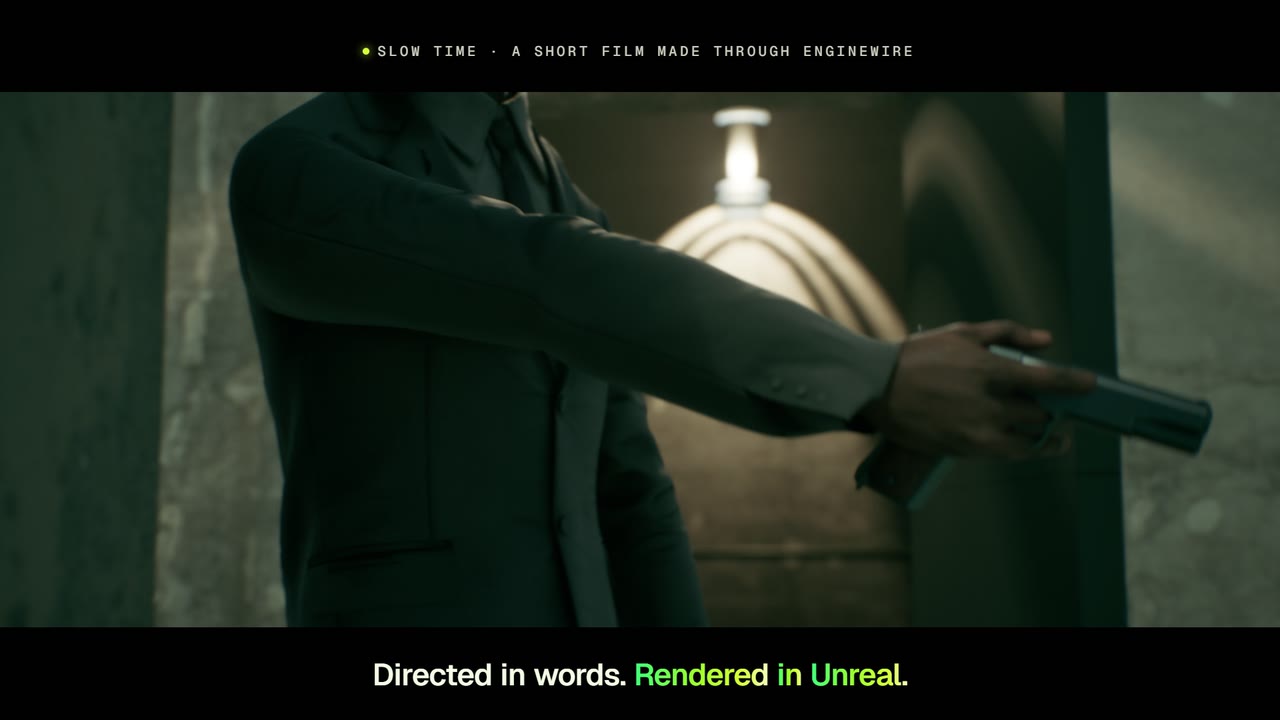
build_environment.configure_atmosphereovercast · the sky, haze and fogClose on the operative’s hand as the pistol comes up.
control_actor.attachPistol_Op to hand_r · the pistol rides his handAcross the deck, he raises the pistol and fires.
animation_physics.create_animation_assetprocedural aim · on target within half a degreeIn slow motion the courier bends back under the rounds. Each one trails a rippling wake through the air.
animation_physics.create_animation_assetprocedural lean · keyed bone by bone, feet plantedmanage_asset.add_material_nodeCustom HLSL · the refracting ripple behind each round, from 0:24Back in real time, he sprints for the air-conditioning unit as rounds spark off it.
manage_sequence.edit_sequence_tracksTransform · a sprint start, keyed every frameFrom behind the unit he shoots back, and spent brass flies.
manage_sequence.edit_sequence_trackscasings · brass on ballistic arcsThe operative leans out from a pillar, and the courier’s rounds chip the concrete by his face.
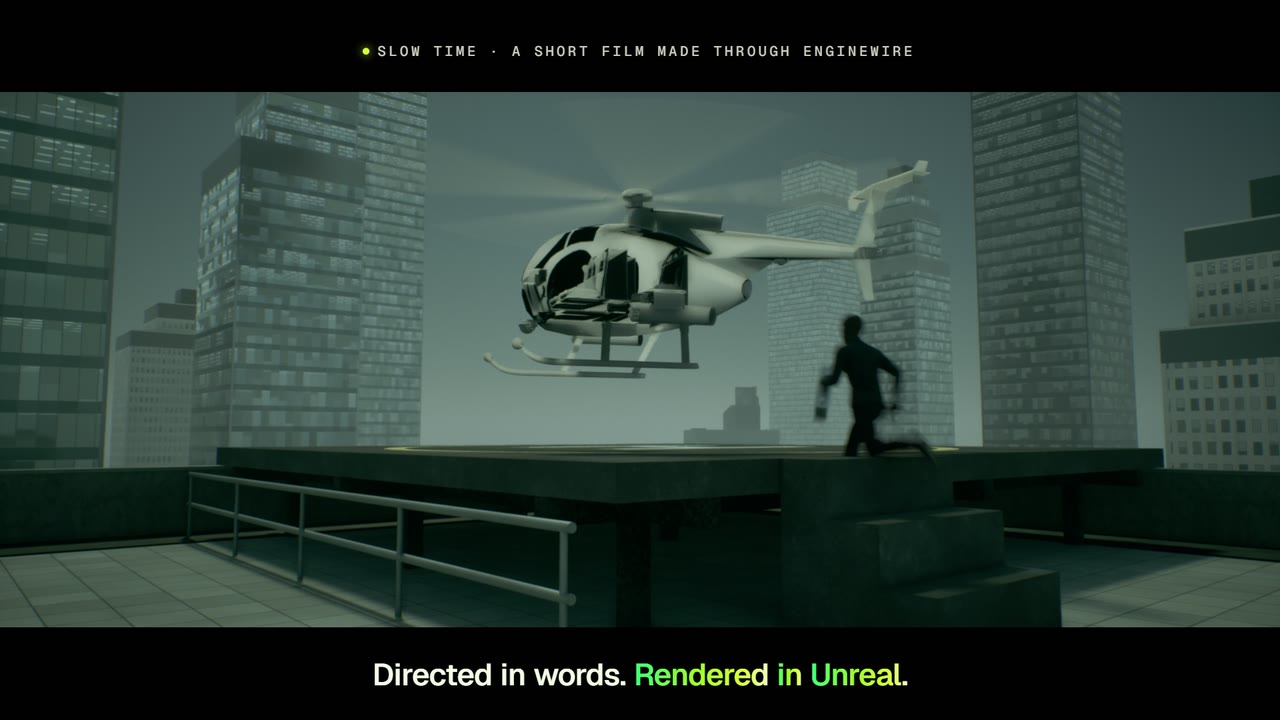
manage_sequence.add_cinematic_trackparticle trigger · concrete chips off the cornerThe courier breaks for the helipad, near misses sparking at his heels.
manage_sequence.edit_sequence_tracksHelicopter · a flight path, banked nose firstThe helicopter climbs away between the towers with the courier aboard.
manage_sequence.create_render_jobMovie Render Queue · 1,007 frames at 16 samples a frame
How it was made
Slow Time was made in an Unreal Engine 5.8 project with the EngineWire plugin and an AI agent connected to it over MCP. The agent had one tool, unreal: it searched for the capability it needed in plain words, read that capability’s contract, and ran it in the editor. A person directed the work over several sessions: what happens, how it should feel, and what to fix. The cut opens on the brief: “Stage an original rooftop standoff at dusk. He fires, time slows, the courier bends under the bullets and escapes.”
The world
The rooftop was built from nothing: a 50 by 36 metre deck with parapets, a stair housing, vents, ducts and a helipad on steel legs. The towers across the street share one procedural facade material, written as a Custom HLSL node: curtain walls, punched windows, blinds and lit offices behind the glass. Below, 392 building models of central London stand on the street, placed in a single batch call. An overcast sky, volumetric clouds and two layers of height fog give the cool green-grey light.
The cast and their motion
The courier and the operative are City Sample crowd characters brought in from Fab. Nine motion-capture clips were retargeted onto their skeleton through an IK Retargeter. Where a clip did not fit the scene, the agent keyed the bones itself: the operative’s arm onto his target, the courier’s lean under the rounds with both feet planted, and the sprint to cover, keyed frame by frame.
To aim the pistols it measured instead of guessing. It snapped small probe actors to the hand and muzzle with control_actor.attach, held the sequence on a frame with manage_sequence.play, read their positions with control_actor.get_transform, and corrected the arm until both pistols pointed at their targets within half a degree. Foot slide was measured the same way and fixed with each clip’s play rate.
The action
Muzzle flashes, sparks, steam and concrete chips are Niagara effects fired by particle triggers in the sequence. Each round is a brass bullet that trails a refracting ripple, and the spent casings fly on ballistic arcs. The helicopter flies a keyed path, nose first, banking into the turn.
The cameras and the render
One Level Sequence holds the film: 24 frames a second, 1,007 frames, and twelve cameras with cuts between them. Movie Render Queue rendered it at 1920 by 804 pixels, a 2.39:1 frame, with 16 temporal samples a frame. Between passes the agent checked its own work with viewport screenshots and camera stills. Other changes came from the person directing: the dash to cover was first staged as a dive and became a sprint into a crouch, and the pillar shot was reframed so you can tell the operative from the courier.
What was made outside the editor
The opening brief, the captions that name each call and the end card were composited after the render, and the score and sound effects were made for this cut. Everything in the picture itself came out of Unreal Engine.
By the numbers
- 12shots, each from a call you can search
- 392London buildings placed in one call
- 9motion-capture clips retargeted
- 0.5°pistol aim, measured on the bones
- 1,007frames rendered by Movie Render Queue
- 16temporal samples a frame
Credits
- Characters: City Sample Crowds by Epic Games, from Fab
- Motion capture: MoCap Online’s free animation pack, retargeted
- Props: a pistol and a helicopter model from Fab
- City: AccuCities’ model of London
- Everything else, from the rooftop to the render, was built through EngineWire.